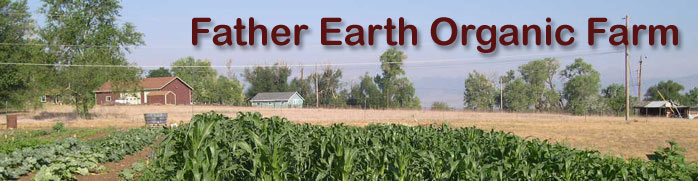
Father Earth Welcomes You
to our 2026 Season!
Hello everyone and Happy New Year! I'm going to begin this blog with a couple of ideas and statements mentioned in my blog from last year.
To be Organic, and stay ORGANIC, I will need to find a solution to pest and insect control and management. A little over a year ago, two of my nieces, Tammi in Missouri and Terrelle in Massachusetts introduced me to "Jadam Organic Farming", "The way to Ultra-Low-Cost Agriculture", AND "Jadam Natural Pesticide".
Throughout the summer, I read about some of the processes that would help me to control and/or eliminate most of these "predator" insects. I made and experimented with a couple of the solutions described in the book and watched several YouTube videos about the "Jadam" methods of pest control. In this new year of 2025, I hope to accomplish my goal of learning how to protect my farm from these predators. It's a very sad thing to see thousands of dollars of food destroyed because of a few predator insects. It just shouldn't be that way!
The Year 2025 brought a lot of Obstacles and barricades to the farms across the nation. There were some successes and some failures. Well, "failures", is a strong and negative word to use here, so I will just say some things that I had planned to go one way didn't produce the outcome I had expected. I started my Lisianthus seed planting as usual in late December 2024 and into the beginning of January 2025. I had Knee surgery at the end of January and took a month to get rid of the walker and the cane. Jill was there 24-7 to assist me in My recovery. Jill and several of my farm family came to help with plants in my basement. I started Statice, Snapdragons, and Globe Amaranth in late February and didn't really consider how fast they would grow in my basement of the controlled environment. My timing was off concerning when they would all be transplanted. March was a windy month, and April was a bit warmer than usual and towards the end of April, we had periodic rain which made it difficult for me to get much planted outside with wind and rain most days. I finally got most of the plants that were started indoors, transplanted to outside beds by the end of April.
I was excited to see the blossoms on the apricot trees and on some of the peach trees but not surprised. March temps had gotten into the low 70's sometime in mid-March, and several of the fruit tree varieties had begun to get fat buds and some flowers were appearing on several trees. Of course, I had seen this early bloom before, so I was preparing myself for a cold spell at some point in the next few weeks. About the middle of April as some of the trees were coming into full bloom, the cold spell hit and killed most of the flowers on the trees. So, no fruit from those trees this year of 2025.
The month of May was a wet one. Only three days of full sun and the rest of the days were rainy of at least cloudy. Fruiting plants need to have sun to grow and to produce a crop. Weeds do well without the sun and so what few crops I had planted before the rains came perished while the weeds took over. By the middle of June, I had to plow up several rows of planted crops along with the weeds and start new beds of veggies. My strawberry plants did not produce at all. No sun and too much rain caused the strawberry plants to die.
As the sun reappeared in June, I was confident that I could still have a harvest of produce outside. I am very fortunate to have produce growing in the greenhouse and cat tunnels because inside and under cover was my main source of food production. The products under cover were sorrel, carrots, tomatoes, peppers, eggplant, cucumbers and basil. By the middle of July, the weather had become more stable and suitable to the growth of plants that the increase in food production was quite satisfying. We had two hailstorms in July that produced pea sized hail, but damage to plants was minimal. As the sun warmed the earth, many insects that hibernate in the ground began to emerge into the light of the sun and onto the leaves of the plants where they would grow and multiply. Grasshoppers were on the top of the list of these predator insects. There were thousands around the farm not only on the veggies, but in the buildings and somehow getting into the house. They loved being in the greenhouse and into the hoophouses. Although they were in the houses that had tomatoes, they didn't do any damage to the tomatoes that I could tell. They did however chew on the eggplant, cucumber, and basil leaves. Outside the houses, they were eating kale, broccoli, cauliflower and bean leaves.
The next biggest predator were the earwigs. Inside the houses, they preyed on eggplant, cucumber, and basil leaves. Outside, they were eating holes in peppers, fruit on the fruit trees, and chewing holes in the chard leaves. At first, I thought the grasshoppers were chewing the chard but discovered that the earwigs were making their home down inside the growth node of the chard stems. I ended up using the JADAM spray solution that I made and got rid of 90% of the earwigs in about two weeks spraying every other day. The Earwigs did more damage on my raspberries in 2025 and strawberries the year before. They teamed up with the Japanese beetles who for the past two years had been chewing up my grape vines. In 2025, they began navigating to my raspberries and a few on my string bean plants. My bees really love my raspberry flowers. They are on them from sun-up to sundown. Even as some of the flowers begin to form into berries, there are still more flowers coming to feed the bees and to make more berries. The earwigs and Japanese beetles begin to come as the berries are just beginning to ripen. I don't spray any areas of plants where my bees are landing. Even if the product says, "safe for bees". I never know for sure what effect the spray will have on the bees.
From my experience over the years, I noticed that earwigs don't fly. Their main traveling action is by crawling from one place to another. Which means that they are crawling from the ground up the stem of the plant to the berries. I began spraying the Jadam solution on the lower branches of the plants and on the ground around the base of the plants. After two weeks of spraying every other day, I noticed that the new berries that were ripening had little or no chewing damage from the beetles.
The earwigs and Japanese beetles do not have the capability to cling onto the plants they are feasting on. Unlike the caterpillar or tomato hornworm that you actually have to PULL off the plant, a little shake of the plant with your hand will dislodge 90% of the earwigs and Japanese beetles from the plant. So, for added protection of my raspberry plants and grape vines, either myself or one of my helpers would take a bucket of soapy water around to each plant and knock the beetles off the plants and into the bucket. This process was done every day in the morning and again in the afternoon.
The spider mites on the cucumbers began about the second week in July. I did what I could to keep them at bay with the Jadam spray but had too many other tasks to do to keep up with them. By the middle of August, my cucumber crop was reduced by about 80 percent. The tomato hornworm arrives on the tomato vines about the first of July. I was quite diligent at discovering them and even would take one or two of my team to pick them off usually twice a day for about 15 minutes at a time. I showed my team how to locate the worms by looking for chewed on leaves and looking for tiny holes in the leaves. We found many large worms (the size of my baby finger) that we had missed a week before. We also found many smaller ones that were smaller than the tip of a toothpick. I noticed that some varieties of tomatoes were not bothered by the worms as much as other varieties that were totally overcome with worms. Sometimes we found several worms on one plant at all stages of growth. I would say that not only were the tomato leaves chewed on, but 5 - 10 percent of the actual tomato had been eaten. The flea beetles wiped out my first bed of turnips. I did my usual planting and as the seed germinated and popped out of the ground, the flea beetles were on them instantly. I used some diatomatious earth dust for a couple of weeks that helped and then a couple of rains washed the D-earth off the plants. I then began using the Jadam solution on the plants and finally got the beetles under control. I sprayed every other day for about two weeks. When I began spraying, the turnip leaves were riddled with holes. After two weeks of spraying, the new leaf growth showed little or no beetle holes.
Earlier in the spring when my lettuce was looking pretty good, I saw deer tracks in and around the heads of lettuce. Several (a couple dozen) lettuce heads had been eaten. I placed a few markers near the eaten lettuce heads to show if new heads would be eaten. Two days later, more heads had been eaten. I sprayed the lettuce bed with the Jadam spray and there was no further munching of my lettuce from the deer. A similar occurrence happened with my corn. A few days before I thought the corn was ready to harvest, several corn stalks were pulled down and some of the corn was half eaten. Two days later, more corn stalks were pulled down and corn eaten. The raccoons were still testing. Although skunks enjoy eating corn, they usually aren't strong enough to pull the stalk down to the ground. I wasn't about to give the raccoons a third chance. I sprayed corn silk tops of all the corn. I'm sure the raccoons came back but no more corn was taken down and eaten. So, I'm confident that the Jadam spray must be doing something that I needed help with. My fruit trees and grape vines didn't produce much fruit this year, but whatever fruit I did have was taken by the birds and squirrels. Not sure what to do about the fruit right now, but I'll read up more on how the Jadam solutions may be able to deter birds and squirrels. I'm excited about the possibilities of the Jadam solutions I made and tried.
I DID have some success controlling and eliminating several predator insects from my crops in 2025. I can see already that 2026 will be a better farming year than 2025.
I should add that this 2025 was not a good year to plant a cover crop here on the farm. I used Johnny's Seeds cover crop mixture to Enrich the soil with both nitrogen and organic matter. I usually plant this mixture on about one quarter to one half acre for winter growing. I planted in October this year 2025 and in a "normal" year, we would get some rain and then some snow to serve as moisture during the months of November, December and January. This winter here in Lafayette, we have had two small snowstorms of 6 inches or less which provided little or no moisture at all. We are now into February of 2026 and as I walk my fields, I don't see any signs of growth from any of the seeds I planted in October 2025. We have had way, way more wind this winter than I have seen here and the intensity of the winds have caused a lot of soil erosion and structural damage to my farm buildings and greenhouses. Looking forward to making the adjustments I need to make to keep the positive energy going here on the farm.
Father Earth Organic Farm welcomes
you to 2025!
As we move into a new year, I always like to be and feel positive about the possibilities of
greater things to come. Although 2024 was a good year for food production, it was not a Great
year. Normally at the beginning of each year I test the inventory of seeds that I currently have.
Most tested pretty good and I only had to order a few new varieties. We had a few warm days at the end of February and beginning of March that allowed me to get out into the hoop houses and get those cleaned up for the year's growing season. In March of 2024 between March 13th and March15th we received a little over a foot of snow. Some of the snow was heavy enough to topple one of my 35-foot apple trees in the front yard so that was a little bit of a disappointment. I was going to finish cutting down that tree and about the middle of April the tree started budding and then came some apple blossoms, so I decided to let the tree continue to grow and produce apples. By the end of the season, we had apples from that tree. I don't expect that I will keep it another year laying on the ground like it is but at least it got to produce some apples during its final days.
A few years back, I built a 10' x 10' hoophouse to keep plants in the shade when I bring them out from the house. The winds had been blowing part of the night of April 6th, so I had expected to see a lot of debris and pots and trays blown around the farm. What I didn't expect to see was my little hoophouse sitting partially on the ground and on my pickup truck. The wind had picked it up and moved it some 50 feet over a 4' fence and landed on my truck. I also had a 10' x 10' canopy that was totally destroyed, including the frame. My bad, I should have taken the cover off.
On the morning of May 7th while surveying my farm, something seemed to be out of place. I looked around but didn't see the small hoophouse. Further investigation located the hoophouse behind the big greenhouse clinging to the barbed wire fence along the railroad tracks. I am not
sure how long it had been there, and I know that several trains had passed that area and had missed hitting the hoophouse by about 15 feet. It was very fortunate that the barbed wire fence was there. From where the hoophouse was initially located to where it finally landed, was a good 100 yards, the length of a football field. The hoophouse frame was totally bent up and beyond repair.
At the beginning of April, I was trying to think of a way to get my tomato plants in the ground earlier than the usual May timeframe. I have been growing tomatoes in grow bags for several years with pretty good success. I had a bunch of 2" thick Styrofoam panels and decided to use
those to insulate the grow bags from the cold ground. I bought some heat cables, the kind that
people use to keep ice from forming in gutters on their houses. I placed them under the grow
bags and on top of the Styrofoam panels. For two months, the tomato plants grew very well and
even started to flower two weeks earlier than the normal July flowering. By the first of July,
something didn't look right with the tomato plants. The leaves began to seem like they were
drying up and were turning a bit yellow. I tried more watering and more compost tea, but that
didn't help. I then realized that the grow bags were still sitting on the Styrofoam insulation and
some of the tomato plant roots were breaking through the bottom of the bags and were drying
out. With the help of a couple of volunteers, we removed the Styrofoam panels and set the
grow bags directly on the ground. Within a week, the tomato plants began to look and grow
normal and continued to produce the rest of the season.
By the middle of July, the predator insects were in full force on the farm. There were more
grasshoppers this year than I have ever seen on my farm over the 20 years I have been
growing here. They were very destructive, eating and chewing everything in sight. They ate all
the leaves off the potato plants, the string bean plants, and the lemon trees. The grasshoppers
and the earwigs chewed eggplant leaves, chard leaves, and kale leaves. The Japanese beetles
ate most of the leaves on the grapes and started on some of the fruit trees and string bean
plants (second planting). Mice ate all the sweet pea shoots as the seeds sprouted in the
hoophouse. Then came the spider mites on the cucumbers and the tomato worms on the
tomato plants. The grubs, snails, pill bugs, and earwigs destroyed most of my strawberries.
The carrot maggot destroyed most of the orange carrots in the west field and near the end of
the season, the aphids infected the lettuce and the kale plants and the white fly infestation on
the sorrel in the greenhouse was overwhelming. We were lucky enough to get apricots last year even though half of them had holes where the earwigs had invaded. And to top it off for the season, the YELLOW JACKETS took over and killed my BEE HIVES!!
Maybe now you can see why some farmers just give up and stop farming. In order to be, and
stay ORGANIC, I will need to find a solution to pest and insect control. A little over a year ago,
two of my nieces, Tammi in Missouri and Terrelle in Massachusetts introduced me to "Jadam
Organic Farming", "The way to Ultra-Low-Cost Agriculture", AND "Jadam Natural Pesticide".
Throughout the summer, I read about some of the processes that would help me to control
and/or eliminate most of these "predator" insects. I made and experimented with a couple of the
solutions described in the book and watched several YouTube videos about the "Jadam"
methods of pest control. In this new year of 2025, I hope to accomplish my goal of learning how
to protect my farm from these predators. It's a very sad thing to see thousands of dollars of food
destroyed because of a few predator insects. It just shouldn't be that way!
Father Earth Organic Farm welcomes
you to 2024!
Another year is upon us, and it is time to begin planning for the greatness this new year has to offer. But before we move forward, we must reflect on past years so that we know what to focus on this year, in order to make this year Great, or at least better than previous years. The year 2023 brought us many unexpected obstacles that caused a few vegetable growing problems. In a "normal" year, I would begin sowing and planting some veggie seeds such as carrots, beets, lettuce, greens, and turnips, outdoors in March and April. We had a very cold winter in 2023 which caused a lot of ground to be frozen, or not workable. So, we got a later than usual start with planting those crops. The planting of crops in hoophouses was also delayed because the nights in March and April were not warm enough to keep baby seedlings from freezing.
What few plants that were beginning to establish themselves in March and April, were soon to be overcome by the wetness of the soil and lack of sunshine in the months of May and June. There was rain of some intensity every day in May except for just 4 days. June was about the same but had sun five full days. With all that rain, most days were cloudy and no sun. Plants need sun to grow and produce fruit or vegetables. Some plants just sat there in the ground without an inch of growth for two or three weeks. While the veggie plants were waiting for the sun, the weeds took over and outgrew most of the veggie starts. I had SOME help with weeding, but not enough to keep up with all the weed growth. By the middle of July, I had mowed down 15 to 20 rows of veggies and began prepping the beds to start over with some new plantings.
And if that wasn't enough to discourage or frustrate someone, the abundance of rain helped to produce lots and lots and lots of grasshoppers. It was more grasshoppers that I have ever seen on my farm. You could walk through my farm and with every step, 30 to 40 grasshoppers would jump to a new location, and sometimes, jump on you. Grasshoppers can cause a lot of damage to vegetation, and so they did! But we can't blame all the plant destruction on the grasshoppers. We had a lot more earwigs, pill bugs, crickets and Japanese beetles than I have ever seen on my farm. OH yes, I almost forgot Tomato worms. Hundreds!! I taught my garden crew how to spot tomato worm damage and locate them and pick them off the plants. Every day we would take 30 minutes and go through the hoop houses and greenhouse and hunt tomato worms. I tried using a couple of organic sprays to ward off these pests but wasn't very successful.
July and August were hot months. The temps were above 90 most days. We started work most days at 8:00 am and my crew was done at 1:00 pm. Most crops did well as long as I kept them watered daily. Lettuce didn't do that well and my strawberries stop producing. I found out that some varieties of strawberries do better than others in the hot days of summer. I ordered 250 "hot weather" strawberry plants for this year to be delivered first week in April. Cucumbers did well from July to about mid-August when the hoop houses begin to get spider mites. Again, I tried some organic sprays that helped some, but eventually, I was forced to remove the cucumber plants from the hoop house. Earwigs were also a problem on the cucumbers.
Recently, one of my grand-daughters introduced me to "JADAM" method of ultra-low-cost organic agriculture. My granddaughter is starting an organic farm and shared this author's information with me. I bought the book and will be studying how to make my own organic pesticides that will kill or suppress 167 kinds of insects, so I'm told.
As I write this blog, the current temperature is -8 degrees. For the past few days, the night temperatures have been below zero and the day temps have only been in the single digits. I am so looking forward to warmer days and nights when I can get outside and get this growing season started. All I can do now is stay inside and get my seeds tested and ready for planting. I am also starting a few flowers and herbs started. Looking forward to a year of growth and prosperity.
Father Earth Organic Farm Welcomes you to 2023!
As we move into this new year, I am excited about the growth possibilities for myself, the farm. and especially for the food that will nourish us all through another year. I began my growing of plants for the 2023 season in December of 2022. Lara, a neighboring farmer presented me with a few garlic bulbs that she had left over from her plantings. With the help of a few volunteers, Mary, David, Caleb, and Nicolas, we planted an 80-foot bed of 5 rows of garlic on December 10, 2022. That was just a part of my preparation for the 2023 season.
People have asked if I take the winter off, or what do I do during the winter? This has been a very cold winter here in Colorado, and I would love to be on a warm beach somewhere, but there is a lot to do to get things ready so that my customers can begin enjoying my fresh organic produce by the time the Farmers market opens in May. I have already planted garlic, but that's just one item.
Seed and plant ordering is another task that takes a lot of figuring and timing, but what and how much do I order? Before I order anything, I need to know WHAT to order. I have over 300 varieties of vegetables that I grow or have grown here on the farm. I have over 30 varieties of tomatoes alone. So, at least every other year, I go through a "seed testing" process to make sure my current seeds are viable for the upcoming season. Here is a brief description of the "seed testing" procedure that I use, and the same information that I share with my gardening group and with the apprentice who come to the farm to learn gardening.
Before we place our orders for new seed, here are a few tips that may prevent re-ordering later. Years ago, I would order seeds in December or January, only to end up re-ordering some seed again in May, June or July. It was frustrating to find out in June or July that some seed I planted in April or May, did not germinate. I'm certain that most gardeners have planted seed and waited, and waited, for something to sprout, but nothing happened.
There are many reasons why "nothing" happened, but for sure, "something" happened... just not what we expected. Maybe the seeds were washed away by a week of rain, or a 4-hour down pour of rain. It could have been a late snow that killed the sprout, or insects, animals, or birds eating the seed. Many times we waste time and energy pondering over what might have happened, when, in my experience, the problem has been in the seed itself 90% of the time. I find that testing the seed will eliminate a lot of the guessing when your seed does not germinate as expected.
I normally begin the seed testing process in November. I have hundreds of seeds to test, and that process takes several weeks. You can use any absorbent paper (tissue, toilet paper, paper towel), but for larger seed (beans, fava, corn), the paper towel works better.
Tear or cut the size of paper you need to be able to fold it to secure the seed. Using a color marker, dab a spot on a corner of the paper. Use the same color to dab a spot on the notebook or paper you are using to keep a record of what you are testing. Write down the seed name, date, company, and variety of seed being tested beside the color dot. (you may use the attached record keeping tool or other means). Place 3 - 5 seeds on the paper. Fold the paper to secure the seeds. Dip the seed towel in a cup or bowl of water and place the folded paper with seeds in a clear plastic cup or glass jar. You can save space by placing 4 or 5 seed packs in the same jar or cup, as long as you can identify them. As an example, I would place 5 different varieties of tomato seed towels in the same cup, each with a different color code for identification. I would place a removable label or piece of tape on the jar or cup that just says, "tomatoes". I use less labels or tape if everything in the cup or jar is the same type of veggie or flower.
The two most controlling factors for seed germination are heat and light requirements. Most seed will germinate is a warm (65 to 75 degrees), dark place (in a closet, or cardboard box that can be closed or covered). If the seed pack says to plant the seed 1/8 inch to 1/2 inch deep, the seed will need some light to germinate (near a window, or in a place where some light is available). Read the seed package. Spinach, cilantro, and lettuce will probably not germinate at 70 to 80 degrees like tomatoes or beans. So you will need to find a cooler place for your testing of these types of seeds. Read the seed package to see what growing requirements each seed needs. The package will tell you how many days it will take the seed to germinate, given the right conditions of course. Check your test seeds daily. I usually give the seeds one and a half times the germination time that the package says to show a sprout. If the package says germination in 4 days, and there is no sprout in 4 days (plus 2 more days), I will toss the test seed and package, and place that seed on my new order list.
Now that I have my list of seeds to order, from whom do I order? I have several seed companies that I order from here in the US. Johnny's, Fedco, Harris, Territorial, Baker Creek, Swallowtail, Totally Tomatoes, and a couple more. All these companies sell "Non-GMO" (Genetically Modified Organism) seed, and I can purchase organic seeds from them when available.
For fruit trees or berry plants, I order from Stark brothers, Indiana Berry Co, Nourse Berry Farm, and Raintree Nursery. Many times, it's a matter of where can I get the best seeds or plants at the most cost-effective price. As an example, I could buy 25 strawberry plants from Johnny's for a price of $35, or I can get them from Indiana Berry Co for a price of $24. And because Indiana Berry Co is in Indiana, and Johnny's is in Maine, Shipping charges from Indiana is so much less than packages coming from Maine.
So here we are in the middle of February 2023. Ninety percent of all the seeds and plants I ordered in December and January, have arrived and I have begun planting seeds in containers in my basement.
The process for having fresh Organic produce available for my customers by May, began in December 2022, when I searched through several seed catalogues looking for the best veggie varieties that would do well here in Colorado. I went though my current inventory of veggie, flower, and herb seeds to see what I needed to restock for this 2023 season. I remembered using the last seed in multiple seed packs last year and was reminded of such actions by the empty seed packs that I had saved from last year. I wanted to get any early start on ordering seed for the 2023 season because several varieties of seeds were "out of stock", in several companies that I had ordered from last year. Since Covid began in 2020 and 2021, more and more people were growing their own produce and hence companies were running out. Even though I ordered some items in December, there were items that were out of stock and will not be restocked until April or May. For some veggies such as tomatoes, the months of April and May are too late to get tomatoes started.
I usually start flower seeds in late December or early January. Some flowers take as long as 6 months to produce a flower. So, starting in January will produce a flower in late June or early July. Lisianthus is one such flower. It is a beautiful (annual flower here in Colorado) flower that looks a bit like a rose, but with less fragrance and will last twice as long as a cut flower than a rose. Some veggies that take 3 or 4 months to be ready for harvest are also planted in December and January. Onions, scallions, parsley, and chives have been planted and are growing nicely in the basement. I am patiently waiting for some warmer nights so that these veggies can be placed in an unheated greenhouse so they can continue to grow before being transplanted in the fields in April and May. The nights here are still very cold and if plants are placed in the greenhouse now, they would certainly freeze. Last night had a low of 12 degrees and it is expected to be 8 degrees tonight.
Before the winter began, I installed a heating system on one of the shelves in the greenhouse. Two days ago, I placed a couple of potted plants of onions and parsley on the shelf as a test to see how the heated shelf would work. Today, February 15th, I put my boots on and walked through 5 inches of snow to check on the plants in the greenhouse. I was surprised to see that the plants were still alive and healthy and showed no signs of frostbite, even though I had placed a tray of water on the shelf above the heated shelf, and the water in the tray was frozen. So, I will check again tomorrow after we have 8 degrees tonight and see if the heated shelf is really going to work.
February 28, 2023: If you read the above paragraph, you are probably awaiting the results of the "experiment" I tried with the heated shelf. Well, that was two weeks ago, and a lot has happened since then. Over the past two weeks, we have night temperatures of anywhere between -9 degrees up to 21 degrees. Even on a heated shelf, the plants could not survive. So, back to the drawing board. I believe I will wait until the night temperatures are in the mid twenties and try again. More to come.
Father Earth
Organic Farm
Lafayette, CO 80026
Cell: 720-849-3484
Home About Us What We Grow Greenhouse / Hoop House Honey
CSA Farm Journal Farmer's Markets Farm Helpers
Consulting Services Health & Wellness Products Contact Us
© 2008 - 2025 by Father Earth
Organic Farm.
All Rights Reserved.
Father Earth Organic Farm is a
small family farm in east Boulder County, Colorado that
provides quality, locally grown, organic vegetables,
fruits, and herbs. We have both a CSA program and a
farm stand. We offer hydroponically grown tomatoes and
peppers. All of our produce is non-GMO. Father Earth
Organic Farm is a small family farm in east Boulder
County, Colorado that provides quality, locally grown,
organic vegetables, fruits, and herbs. We have both
a CSA program and a farm stand. We offer hydroponically
grown tomatoes and peppers. All of our produce is non-GMO.
Father Earth Organic Farm is a small family farm in
east Boulder County, Colorado that provides quality,
locally grown, organic vegetables, fruits, and herbs.
We have both a CSA program and a farm stand. We offer
hydroponically grown tomatoes and peppers. All of our
produce is non-GMO.
|
|